Wednesday, November 22, 2006

Visual Thesaurus 3


In my effort to find tools that are both fun and engaging to use, one that stands out is Visual Thesaurus. Visual Thesaurus is like no other thesaurus you have ever used. Just type a word into the text box and watch as an animated web is drawn with your word in the center with related words connected to it. Different colored links depict synonyms or antonyms and students can click on any word to see another whole set of related words. Just hover your mouse over the word and the definition appears. It is easy to drag the definition to Microsoft Word if you need to capture it for a written assignment. Students can try out Visual Thesaurus at ThinkMap. Give it a try on the web and let me know what you think!

Great Example of Group Collaboration - e-Book: E-learning Concepts and Techniques

I found this via Eric Tremblay - e-Learning Acupuncture: Q: Does group collaboration online work?

E-Learning Concepts and Techniques is a collaborative e-book project by Bloomsburg University of Pennsylvania's Department of Instructional Technology students and guest authors. It was a project-based assignment for the online class, E-Learning Concepts and Techniques Spring 2006.

As an example - look at the section on Instructional Design Models. Quite well done. This is both a great reference piece and a great introduction to eLearning.

A link to the assignment.

Great stuff.

Tuesday, November 21, 2006

Mindjet MindManager 6


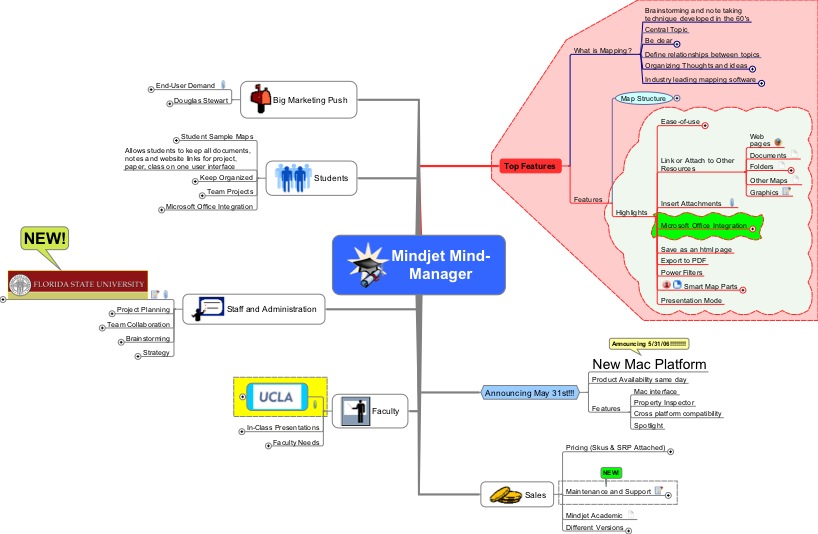
I have been using Mindjet MindManager 6 for the last 6 months and find it to be an indespensible tool for teaching and preparing my classes. Having information in a visual mind map is a great way to get an overview of what is being presented. Mindjet MindManager 6 seamlessley integrates with Microsoft Office and is wonderful tool as a repository of links, documents, spreadsheets, RSS feeds, Outlook task, and Outlook appointments. With so much going on it is nice to know that I can open one document and get a snapshot of all the material in one location. Mindjet MindManager 6 is a very powerful tool that you will find easy to use and is great as a presentation tool as well. If you are interested in taking mind maps to the next level then look no further than Mindjet MindManager 6.

Guy Kawasaki - Art of Panels

Good post by Guy - The Art of Panels. He points to some other good resources:

I generally agree with everything presented with one exception - preparation and PowerPoint. Panels where the speakers just show up and answer questions often end up rambling and not nearly as effective as panels where speakers are prepared for introductory discussions and context setting. As a moderator I always have speakers prepare a few context setting slides and have them prepared for the topics we'll be covering.

At the same time, I agree with the suggestion that you don't want too much preparation. Instead the point is to drill into key issues and show parallels and contrasts in view among the panelists. So, from a more prepared context setting (often with PowerPoint slides to support) you go into a back-and-forth as discussed in the above pieces.

Monday, November 20, 2006

Clark Aldrich - "Second Life is not a teaching tool"

Clark Aldrich's recent post on LCB - The Learning Circuits Blog: Second Life is not a teaching tool - has me wondering what he thinks a "teaching tool" is?
Having said all of that, Second Life, as is, is not a teaching tool. It is content free. It is closer to a virtual classroom tool, or even a real-world meeting room or water cooler (without the actual water). Any content has to either bubble up from spontaneous conversations (great when they happen, but not predictable or scalable enough to provide an intellectual payoff), or be "brought in."

Ummm ... but aren't virtual classroom tools or meeting room tools a "teaching tool" if used correctly? And, if you are able to enhance these with persistent content, doesn't that become a teaching tool.

How about the ability to fly around the solar system? Could you maybe learn about the solar system that way? That's in there?

I think maybe Clark is more worried about distinquishing something from something:
mostly, I worry that educational simulations will be lumped together with Second Life

Not sure the point he's making. If someone scripts a simulation in Second Life, does that not count or something?

No matter what Clark says - Second Life is a teaching tool.

I personally believe that the next generation of Second Life that gets around some of the current technical issues and provides presence audio is going to have adoption patterns similar to virtual classroom / virtual meeting tools.

Knowledge Management Core Issues

Great post by Denham Grey - Perennial KM issues that are very similar to the core problems that we deal with in eLearning:
  • How to speed learning, increase awareness and share experiences.

    With an ever deceasing half-life of knowledge , just keeping up has become a major corporate imperative. Sure we have improved search engines, more stuff on the web and many ways to make connections, but the difficulty is making sense and finding people really 'in-the-know'. We need practical ways to build personal informal networks.
    Helping groups learn from mistakes and errors, practices to carry over learnings from project to project and improve corporate memory. We have made little progress in preventing those repeating errors, as firms grow in size and complexity, building relationships that enable knowledge flows, keeping in the loop and finding stuff becomes a huge issue. Could we improve the situation by adopting some emergent mindsets & web2.0 practices?

  • Discovering opportunities and gaps in knowledge flows, improving personal networking and finding experts (in larger firms).

    This requires ethnographic digging, an understanding of the organization, a deep appreciation of knowledge practices and emergent affordances. Not many firms recognize or care about sub-optimal performance in this area - the results you see, are diffuse, obtuse and difficult to fit into classic ROI models.

  • Providing environments, tools and processes that encourage informal learning, knowledge sharing of effective practices and stimulate innovation.

    Communities of practice, incentives & recognition for personal mentoring, story collection and telling, cross-domain and silo sharing can be useful, but there needs to sustained executive drive and support for this to have an impact.

  • Improving competitive advantage, agility and adaption by making staff more aware, sharing the small insights, building on incremental improvements.

    Open space methods, creating forums and 'Ba' for trusted exchanges, blogging and informal wikis may help. Once again top level support, legitimization and walking the talk - leading via example is the key.

  • Finding tacit knowledge sources and helping to put these to work.

    Tacit knowledge discovery is tedious, slow and difficult - most firms shy away from allocating resources to projects dealing with intangibles, where outcomes are unknown and ROI is hard to prove. As knowledge retention becomes an issue due to workforce transitions, this problem is not going away soon.

Great stuff Denham.

Monday, November 13, 2006

Social Bookmarking for Link Sharing

On TrDev, we've been discussing the sharing of links via forum posts vs. social bookmarking tools such as del.icio.us. I've discussed this before:

But it might be worth looking at how Nancy White has been doing this. See her recent post about Second Wave Adoption and her follow-up post on Time to Experiment. She lets folks know to use the del.icio.us tag "2ndWave" and then you can look at the list of links that she and others have collected.

The nice thing about doing it this way is that you have those list of links available to you later. Why is that important? Well how many of us will actually go through and read the links right now? With del.icio.us (and better yet Yahoo MyWeb), you can go back and find them later. Ever had the experience of going back and searching for the list of links?

Of course, the question is whether people will adopt this. Any thoughts?