Thursday, November 9, 2006

Use of iPods and other Mobile Learning

Not sure if this came from the same person, but I saw a question posted on TrDev and was sent to me via Yahoo 360 that covered the same basic topic: How are iPods and PDAs being used in corporate learning applications?

The unfortunate answer is that it's doubtful that any numeric answer exists for this, but there are lots of examples out there. Some places I would suggest you look to get a sense of what's going on:
Search under "mobile learning" and you'll find a ton of stuff.

If anyone knows a source that will give us an idea of "how much this is happening" - that would be great.

Wednesday, November 8, 2006

Facilitating Adoption of Web 2.0 Tools

Nancy White just posted Second Wave Adoption where she discusses various aspects of helping adoption of Web 2.0 type approaches. This is definitely an interesting question and something I've written about before:

These posts may be worth reading, but the basic gist is that adoption starts from the personal utility - actually its the perceived usefulness (PU), but that's roughly the personal utility.

Nancy's post has some ideas (slides) about how to facilitate adoption and she points to a few other posts: Focusing, Stimulate people's imagination, trigger inventiveness.

I simply wanted to add to what she is saying that adoption is going to be dependent on us first learning how to use these tools ourselves and then showing others. Maybe take a look at:

Second Life and Learning

I just read through a great post by Rich Hoeg which talks about his learning around Second Life. A few of the things he points you to:

These are great resources and will likely open your eyes a bit. I think that Second Life is not going to turn out to be the winner because of technical issues, e.g., firewalls. However, I think that the next generation of Second Life will displace tools like WebEx for many online events. Once you add in presence audio (you hear people close to you) and whiteboarding tools, it will make for very interesting opportunities.

Monday, November 6, 2006

Will Richardson - Owning the Teaching…and the Learning

Must read post - Owning the Teaching…and the Learning. A few comments - but make sure you ask yourself if you fit into this yourself around use for corporate learning:

I hate to generalize, but the thing that seems to be missing from most of my conversations with classroom teachers and administrators is a willingness to even try to re-envision their own learning, not just their students.

Lots of teachers I talk to want blogs and podcasts and wikis. Without question, there are thousands of teachers, tens of thousands in fact, who are already using the tools with their students. I see new examples every day. But I’m still bothered by the fact that very, very rarely do I see new pedagogies to go along with them that prepare students for the creation of their own learning networks. That allow them to take some ownership (or at least envision the possibility of it) over their learning. That help them learn self-direction and get them to stop waiting for someone else to initiate the learning. And even rarer is to find one of those teachers exploring his or her own learning through the tools.

More than anything else, I think, teaching is modeling.
While his audience is a different audience, I think a lot of what he is saying applies to us. This is something that I've mentioned before:
but Will's post really crystalizes the thought. And challenges each of us to do more.

Stephen Downes is Wrong? Is It Really Cool?

After Stephen and I recently lamented in our blogs about the problems with comments getting buried (see How Do People Interact with Blogs and Stephen's comments) - now I'm completely throwing away all blog norms because I don't want my response to Stephen on a different topic to get lost.

My recent post - Incredibly Cool! Vision of Future of Application and eLearning Development - Stephen responded:


OK, I know why Tony Karrer is calling this "incredibly cool," but no, it's not, it's a mess. I know it seems really cool, because it brings so much stuff into a page. But I couldn't put my mouse down n it anywhere without clicking on something, windows would stay open, I have tabs piling up on each other, and through all of it I couldn't find anything useful, and there was no place to actually create anything. We're not there yet - Web 2.0 is going to be, more than anything, simple, not a horrendous desktop mess.
I just have to respond to the "it's a mess" comment. I agree with Stephen that right now this stuff is early stage and it's a mess. I'm not planning on using that particular tool anytime soon. It's more of a toy than anything else. Oh, I am using something similar to create my personalized home page. And, none of that is the point.

The point I want everyone to take away from doing the exercise in the original post is the ease with which you can pull together an application made up of services being provided by separate entities and the ease of doing this authoring of your home page through a web interface.

You need to use a bit of imagination, but picture the objects on the left as a series of Question Types and Interaction Types that you can drop onto your page. This is authoring 2010. And the components may come from places other than your authoring/LCMS vendor. And they can easily include interaction with your learners.

That's all I'm saying. :)

Beyond Search - REAP

via Jack Vinson's post Knowledge workers do more than search, found the article: Beyond Search is REAP. The point is that searching is really just the beginning for most activities. From the post:


Beyond Search is REAP - Retrieve, Extract, Arrange, Present. We’re still not there with the deeper tools and the whole experience we desire for truly reaping the value from all that’s available to us on the Internet.

Consider the typical information work flow of a professional:

  • Retrieve — collect information from a variety of sources
  • Extract — extract data, facts, examples
  • Arrange — arrange documents and facts for use now or later
  • Present — compose information into artifacts of value
Search is just about the retrieve and the -eaping is pretty much left to the person.

This is really on the mark and my only wish is that his article or Jack's had pointed to more help with the rest of the process. But the point made in comments was that the process becomes different quickly. On the other hand, I think there are some common techniques that we all use. I've pointed to a few in various posts probably the most notable are:

This feels like the most important battleground in learning how to learn.

The Big Question for November - Future of ISD / ADDIE / HPT?

November's Big Question on the Learning Circuits Blog has been posted. The question this month is:

Are ISD / ADDIE / HPT relevant in a world of rapid elearning, faster time-to-performance, and informal learning?

To me, this is one of the most important questions facing us today. If you look at the shift between eLearning 1.0, 1.3 and 2.0 – and particularly the shift in who creates content, you’ll notice that the bulk of content creation moves from the learning function to SMEs or workers/learners.

I believe that we will continue to create linear learning experiences (courses, courseware) but that this is going to be a smaller portion of learning. As I've pointed to before: Course and Courseware are Fading - The Future of eLearning. What you have to ask yourself is:

What business are you in? Are you in the business of creating linear learning experiences? Courses and Courseware? If so, then you are the railroads of the future.
Instead, I think of our industry as being involved in the convergence of management consulting, human performance, learning and technology. Our job is to understand the business objectives, understand how human performance impacts them, identify the gaps and opportunities, etc.

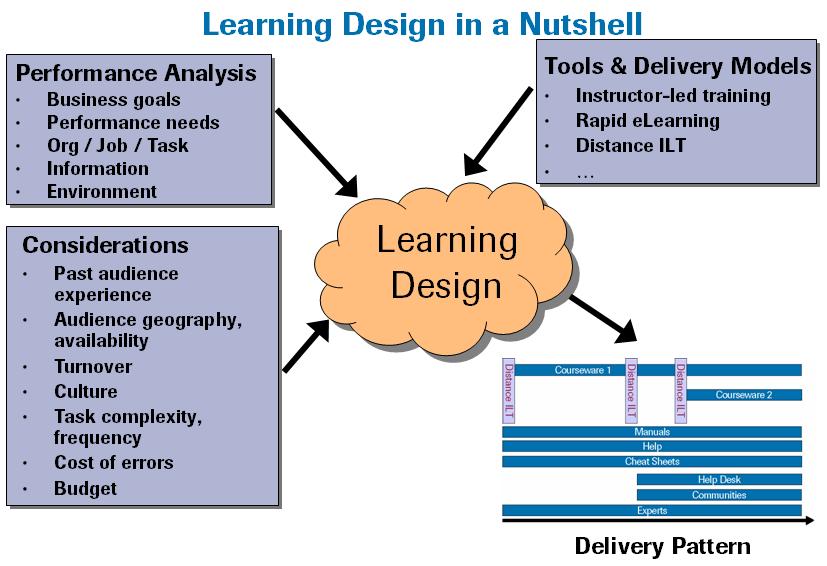
My mental picture of what we do all the time I've shown before (Learning Design in a Nut Shell):


I personally believe that a lot of what we know about analyzing the business issues, human performance issues, information issues, human performance needs are similar today as they were 10 to 20 years ago. There are some new considerations such as greater audience distribution, less time with learners, alternate information sources, etc. And all of this affects the resulting blends. However, the analytic skills we use to understand how to impact human performance are more valuable today than ever.

What has changed is what we produce. At a minimum, we are creating much richer blends. This is probably the easiest change to understand and the easiest transition.

What is much more challenging is that as we look at eLearning 1.3 and 2.0, we change roles from direct content creation and control of delivery to a set-up, aggregator, guidance role. We also take responsibility for helping people “learn how to learn.” (Of course, it would be helpful if we all first became experts in learning how to learn ourselves - see Do Learning Professionals Make the Worst Learners?)

So, back to the question - are ISD / ADDIE / HPT relevant? My answer is a definite: Yes, but. And the "but" is that they will be marginalized unless you do the following:

  • Figure out Rapid HPT, ISD, ADDIE

    Even in the case of eLearning 1.0 solutions (where you create the content) we must become more agile in our models. I personally believe that everywhere in business we are being forced to make choices between fast and best. In software, having something tomorrow may be more important than having all the functionality and maybe not even thoroughly tested. Doing big market research studies may fall prey to just putting it out there and trying to sell it. We have to adapt to faster choices and the fact that we may not have found “the best” answer.Definitely look at Thiagi’s Rapid Instructional Design and One Week Course.

    I'll leave it to Harold Stolovich, Allison Rossett, Ruth Clark and others to talk about how these models can be streamlined, but I would suggest that we all need to ask – how quickly can I get an 80% solution? What is the value of the last 20% vs. the time cost?


  • Increase the Breadth and Improve Your Understanding of New Models / Tools

  • We need to learn when and how to use eLearning 1.0, eLearning 1.3, eLearning 2.0 and other types of solutions.


  • Become Meta-learning Experts

  • We need to learn how to learn ourselves and find systems that support learning even when we don’t create the content. Then we need to be experts at teaching others how to use these systems and learn how to learn.


  • Learn to become guides, aggregators

  • Much of what we'll be doing in the future is not creating content ahead of learning, but working alongside, realtime of our learning community helping them with content, helping them to become better learners, and looking at the content that is being created and improving it, providing structure or guides. It's a radically different model, but I believe there's still relevance in ISD/ADDIE/HPT for this as well.